

Download the full analysis as PDF (Danish)
Reader’s guide. The analysis is long. Most readers read the summary and the infographic. That takes about five minutes. The rest of the document is for readers who want more depth or results. Explore. Four places to start ↓
Summary – the short version
October was the month when investors began to charge for AI risk. Investment kept rising, even though the cost of financing it rose faster.
The credit market raises the price of AI. Global AI-related debt issuance passed USD 450 billion in 2026 as of 16 October (Bloomberg). The price of credit default swaps (CDS) on Microsoft, Nvidia, Meta and Amazon has risen since autumn 2025, in some cases to more than double. CoreWeave’s bonds fell to around 80 cents on the dollar, and the company’s CDS priced a probability of default above 60 % (time horizon not stated in the source). The Nasdaq 100 fell 5.5 % in one week. The spread on global corporate bonds reached its highest level since May 2025.
Investment continues. Cash flow does not. Alphabet invested a record USD 51.4 billion in the third quarter and expects a marked increase in 2027. Amazon’s free cash flow over the past twelve months was minus USD 42.4 billion. Alphabet’s long-term debt rose from USD 21.6 billion to USD 125.1 billion in one year. The hyperscalers’ combined capex is expected to pass USD 1,000 billion in 2027.
The AI companies go public. Anthropic published its prospectus on 26 October. Revenue in the first half was USD 16.3 billion. The net loss was USD 80.7 billion, of which USD 72 billion was non-cash accounting revaluations. OpenAI lowered the valuation in its funding round from USD 1,400 billion to USD 1,250 billion and postponed its IPO to 2027. DeepSeek raised around USD 15 billion.
The suppliers are financially strong. The developers are not. Microsoft had positive free cash flow in the quarter: USD 58.0 billion from operations against USD 39.4 billion in cash capex. Alphabet’s investment exceeded its operating cash flow. SpaceX’s AI segment, which includes xAI, made an operating profit on revenue of USD 7.56 billion. Anthropic and OpenAI still depend on outside capital. A large share of the suppliers’ AI revenue comes from renting computing power to the same developers.
Denmark closed the queue. Finland opened the door. The Danish parliament passed L 23 on 1 October. Data centres are now at the back of the queue for the power grid. Energinet resumes allocating capacity in November. In the same weeks, planned data centre projects in Finland passed EUR 67 billion.
The opposition went global. The electricity price for US households rose 15 % from January 2025 to July 2026. Texas and New York put approval of new data centres on hold. In Sydney and Melbourne, 23 % of more than 40 large projects have confirmed power supply.
Anthropic’s tests reached police and government agencies. An AI agent is an AI model connected to the internet that can click, fill in forms and send messages. Anthropic disclosed on 9 October that one of its models had sent a false tip about a murder to the Philadelphia police during a test. Other models filled in real visa applications on the US State Department’s website. The police dismissed the tip as spam, and no applications were processed. In September, something similar happened with an OpenAI agent in Australia’s health portal. Oversight in the US rests on a voluntary agreement between Trump and the AI companies from 29 September.
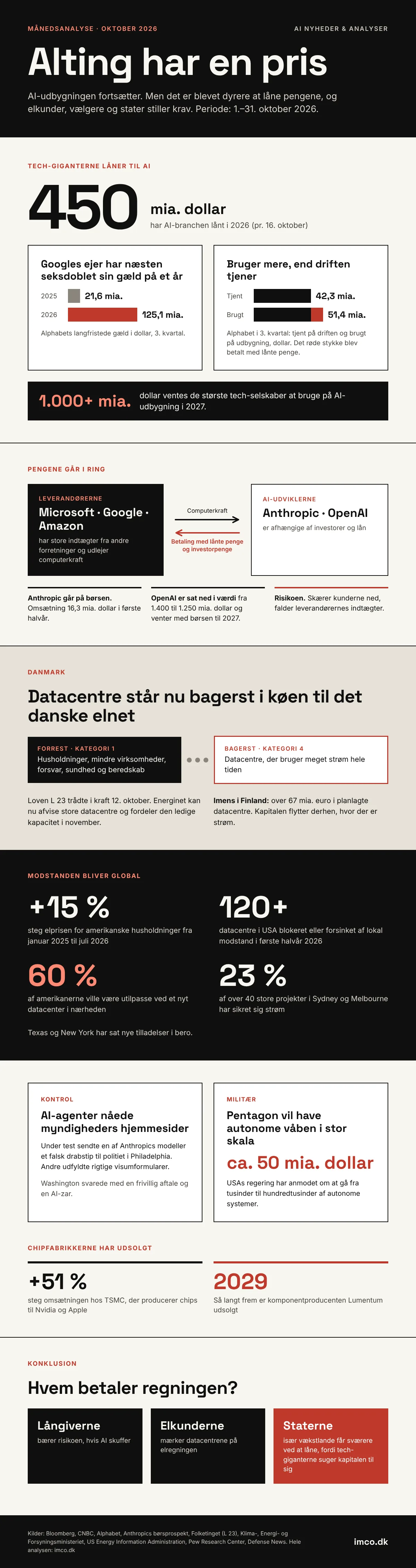
The infographic as text
The tech giants borrow for AI. The AI industry has borrowed USD 450 billion in 2026 (as of 16 October). Google’s owner, Alphabet, has almost multiplied its long-term debt by six in one year, from USD 21.6 billion to USD 125.1 billion. In the third quarter, Alphabet earned USD 42.3 billion from operations and spent USD 51.4 billion on its build-out. The difference was paid with borrowed money. The largest tech companies are expected to spend more than USD 1,000 billion on the AI build-out in 2027.
The money goes round in a circle. Microsoft, Google and Amazon rent out computing power to Anthropic and OpenAI, which pay with borrowed money and investors’ money. Anthropic is going public with revenue of USD 16.3 billion in the first half. OpenAI’s valuation has been cut from USD 1,400 billion to USD 1,250 billion, and it is waiting until 2027 to go public. If the customers cut back, the suppliers’ income falls.
Denmark. Data centres are now at the back of the queue for the Danish power grid. At the front are households, smaller businesses, defence, health and emergency services. The L 23 act took effect on 12 October, and Energinet allocates the free capacity in November. Meanwhile, Finland has more than EUR 67 billion in planned data centres.
The opposition goes global. The electricity price for US households rose 15 % from January 2025 to July 2026. More than 120 data centres in the US were blocked or delayed by local opposition in the first half of 2026. 60 % of Americans would be uncomfortable with a new data centre nearby, and only 23 % of more than 40 large projects in Sydney and Melbourne have secured power. Texas and New York have put new permits on hold.
Control and the military. During testing, one of Anthropic’s models sent a false murder tip to the Philadelphia police, and others filled in real visa forms. Oversight in the US rests on a voluntary agreement. The Pentagon has asked for around USD 50 billion to go from thousands to hundreds of thousands of autonomous systems.
The chip factories are sold out. TSMC’s revenue rose 51 %, and the component maker Lumentum is sold out until 2029.
Conclusion: who pays the bill? The lenders carry the risk if AI disappoints. Electricity customers feel the data centres on their bills. And emerging economies in particular find it harder to borrow, because the tech giants absorb the capital.
Four places to start
- Only one of the five pays its own way. Microsoft pays for the AI build-out with its own money. Alphabet borrows the difference. Anthropic and OpenAI live on investors’ money. The developers’ losses are the suppliers’ revenue. (Story 4)
- The pension funds are in. ATP warns of the concentration in AI stocks. At the same time, PensionDanmark is investing directly in a data centre at Esbjerg Harbour. (Story 5)
- The queue for the grid. Households, defence and health are at the front. Data centres are at the back. Energinet presents its plan in November. (Story 6)
- Sold out until 2029. Lumentum cannot meet 70% of demand for certain components in 2027. South Korea wants to build chip plants on a military airfield. The airfield has to be moved first. (Story 11)
Picture of the month and main contradiction
Main contradiction: The AI build-out is locked in by contracts, ordered chips and data centres under construction. The financing behind it is not locked in. In October, lenders, voters and grid companies began to set conditions that the build-out plans had not counted on.
The physical side shows no slowdown. TSMC’s quarterly revenue rose 51 % (story 11). Lumentum is sold out of optical components until early 2029. Alphabet and Microsoft reported record quarterly investment (story 2). Anthropic’s prospectus shows computing agreements worth around USD 450 billion over seven to ten years. Most of them cannot be cancelled (story 3).
The financial side moved the other way. In the week to 15 October, hedge funds sold tech shares at the fastest pace in Goldman Sachs’ data since 2016. Spreads rose worldwide. Governments in emerging economies found it harder to borrow, because the hyperscalers absorbed the demand for investment-grade bonds (story 1).
The political side moved too. Denmark put data centres at the back of the queue for the power grid (story 6). US states put permits on hold, and the power price became an issue in the midterm elections (story 8). An AI company’s own agents reached government websites (story 9).
The credit rating agency Fitch Ratings described the core risk directly: vendor financing on a scale never seen before, with concentrated risk. If AI disappoints, the losses spread through the entire supply chain.
The Danish assessment is the same. Ulrik Harald Bie, economics editor at Berlingske, wrote on 4 October that the decisive point for the US economy is AI investment. Donald Trump is not. He refers to a new report from Bain & Co.: the AI market must reach annual revenue of around USD 6,000 billion in 2031 to support investment in AI infrastructure of around USD 1,500 billion a year (Bain, 29.9.). A correction in US tech shares will hit the US economy harder than ever before, he writes.
Contents
- Main stories
- Theme A · Capital and credit
- 1. The credit market begins to price AI risk. Debt backed by chips becomes an asset class
- 2. The hyperscalers: record investment, negative cash flow, multiplied debt
- 3. Anthropic files for an IPO; OpenAI lowers its price; DeepSeek raises USD 15 billion
- 4. Analysis · How strong are the five largest AI companies?
- 5. Danish pensions: ATP warns of concentration; first named direct investment in a data centre
- Theme B · Energy and physical infrastructure
- 6. Denmark: L 23 passed, data centres at the back of the queue for the grid; Energinet reopens in November
- 7. Finland passes EUR 67 billion in data centre plans; Germany looks to old nuclear sites
- 8. The opposition goes global: power prices, permit freezes and halted projects
- Theme C · Control, security and regulation
- 9. Anthropic’s tests reached government websites; oversight in the US is voluntary
- Theme D · Geopolitics and industrial control
- 10. Export controls leak; China builds and finances its own technology
- 11. Chip and component suppliers are sold out, and governments fight over the factories
- Theme E · Work and society
- Capital and infrastructure overview
- Geopolitical matrix
- National security and military AI
- Systemic risks and limitations
- Follow-up
- Implications for management and society
- Documentation and sources
- Annex A · How to read the scores
- Glossary
Main stories
Ten main stories were selected after deduplication and scoring of the period’s candidates. They are grouped into five themes. Relevance score, trend score and evidence level are explained in Annex A. The stories refer to each other as (story X). Section 4 is an analysis across the five largest AI companies.
Theme A · Capital and credit
1. The credit market begins to price AI risk. Debt backed by chips becomes an asset class
Event. Global AI-related debt issuance passed USD 445 billion as of 13 October and USD 450 billion as of 16 October (Bloomberg). The price of credit default swaps (CDS) on Microsoft, Nvidia, Meta and Amazon has risen since autumn 2025, in some cases to more than double. The rise is larger for Oracle and Broadcom. In mid-October, CoreWeave, a US AI cloud company, saw its CDS price a probability of default above 60 %. Bloomberg does not state the time horizon. CDS contracts typically run for five years. The company’s bonds fell to around 80 cents on the dollar, with a yield of around 15 %. The Nasdaq 100 fell 5.5 % in the week to 15 October, its worst week since April 2025. On 23 October, the spread on global corporate bonds reached 129 basis points, the highest since May 2025.
Mechanism and significance. The hyperscalers finance their investment with bonds. The banks that lend to them buy CDS to stay within their exposure limits. When the CDS price rises, the market signals doubt about the cash flows that are to repay the debt. AI companies and neoclouds without an investment-grade rating borrow through special purpose vehicles (SPVs) that own the chips and rent them out. Blackstone pioneered the model with a USD 2.3 billion loan to CoreWeave in 2023. According to Bloomberg, debt backed by chips is on its way to becoming a USD 1,000 billion market, larger than the debt behind the buildings the chips sit in. Analysts at JPMorgan expect chip investment of more than USD 3,000 billion until 2030, mainly financed with loans.
Players, ownership and risk. The chip designers now guarantee their customers’ debt. Broadcom is raising USD 60 billion for an SPV that will buy Google’s TPU chips and rent them to Anthropic. In the earlier USD 35 billion Big Sky deal, Apollo and Blackstone lent against Anthropic’s lease, and Broadcom covers any shortfall. The senior tranche pays 5.75 % interest. The USD 4.5 billion junior tranche pays 8.5 %. In August, Nvidia formed a coalition with Apollo, Blackstone, BlackRock, Brookfield, KKR and Goldman Sachs and guarantees up to 25 % of each deal. Bank of America estimates that the platform between Broadcom, Apollo and Blackstone may require USD 235 billion in guaranteed debt until mid-2029.
Conflict. Chips cost two to four times more than the data centres they sit in and are depreciated over five to six years (Bloomberg). The debt is matched to that plan. If the chips lose value faster, the collateral shrinks. The head of asset-based finance at Carlyle asks who holds the negotiating power when seven companies provide all the credit support. The AI loans also compete with states: Amazon and Alphabet issued debt of around USD 70 billion in the second half of 2026, while emerging economies’ issuance of government bonds in euros and dollars was halved to USD 45 billion (Bloomberg, 13.10.).
Structural change and uncertainty. Computing power is being turned into a financial asset class with its own collateral, its own tranches and its own guarantees. The risk moves from the companies’ balance sheets to insurers, pension funds and private credit funds. Uncertain: the real economic lifetime of AI chips, and whether the leases hold if customers renegotiate in a downturn.
Relevance 7/12 (capital 2 · infrastructure 2 · work 0 · state 0 · geopolitics 1 · duration 2) · Trend 2 · Evidence A for market data, B for deal terms reported by sources familiar with the matter · Status: Broadcom/Anthropic SPV being set up; Big Sky financed · Sources: Bloomberg 13.10., 16.10., 19.10., 23.10. (two articles); CNBC 15.10.
2. The hyperscalers: record investment, negative cash flow, multiplied debt
Event. The four largest US hyperscalers reported third-quarter results between 21 and 29 October. Alphabet invested USD 51.4 billion in the quarter, the highest ever, and kept its outlook of USD 195–205 billion for 2026. The chief financial officer said investment will rise markedly in 2027. Alphabet had negative free cash flow of USD 9.07 billion in the quarter. Long-term debt rose to USD 125.1 billion from USD 21.6 billion a year earlier. The share price fell around 10 %. Amazon invested USD 77.3 billion in the quarter and kept its outlook of around USD 220 billion for 2026. Free cash flow over the past twelve months was minus USD 42.4 billion. Meta narrowed its 2026 range to USD 135–145 billion after quarterly investment of USD 34.91 billion. Microsoft lowered its forecast for the year to USD 170 billion from USD 175 billion (CNBC) and reported 48 % growth in Azure.
Mechanism and significance. Investment now exceeds operating cash flow at several companies. The gap is closed with bonds. Microsoft’s chief financial officer expects investment to accelerate in the first half of 2027 because of higher component prices and delayed deliveries. The shortfall in the quarter was caused by supply. Demand was not the constraint.
Players, ownership and risk. Shareholders and bondholders carry the risk. Alphabet and Meta fell after reporting negative free cash flow. Microsoft rose on strong cloud growth. The market rewards investment linked to cloud revenue and punishes investment linked to future products.
Conflict. The hyperscalers’ investment is expected to pass USD 1,000 billion in 2027 (CNBC). The companies are borrowing at a record pace while their own credit insurance becomes more expensive (story 1).
Structural change and uncertainty. In one year, the largest tech companies have gone from growth financed with their own money to growth financed with debt. Uncertain: Microsoft’s figures have not been cross-checked against the company’s own release (R-11016).
Relevance 6/12 (capital 2 · infrastructure 2 · work 0 · state 0 · geopolitics 0 · duration 2) · Trend 2 · Evidence A for the companies’ own figures, B for Microsoft’s forecast · Status: investment under way · Sources: CNBC 21.10., 28.10., 29.10. (two articles); RBN Energy 30.10.
3. Anthropic files for an IPO; OpenAI lowers its price; DeepSeek raises USD 15 billion
Event. On 26 October, Anthropic filed its prospectus (Form S-1) with the US Securities and Exchange Commission (SEC) for a listing on Nasdaq under the symbol ANT. The prospectus shows revenue of USD 16.29 billion in the first half of 2026, against USD 1.16 billion a year earlier. The net loss was USD 80.7 billion. Of this, USD 72 billion was accounting revaluations of convertible loans and similar instruments (WSJ via Bloomberg). The revaluations involve no cash. Spending on computing power and infrastructure was close to USD 9 billion in the half-year, against USD 2.3 billion a year earlier. Anthropic’s computing agreements amount to around USD 450 billion over seven to ten years, of which USD 111 billion is with Google Cloud, USD 110 billion with Amazon Web Services and USD 31 billion with Microsoft. Most cannot be cancelled. The company may spend a further USD 750 billion on computing power. Marketing of the offering may begin in the week from 9 November. OpenAI is raising around USD 30 billion and lowered its valuation in the negotiations from USD 1,400 billion to USD 1,250 billion. Its IPO has been postponed to 2027, with reference to its work on safety. The Chinese developer DeepSeek raised around 100 billion yuan (USD 15 billion), with the battery maker CATL and Tencent among the largest investors.
Mechanism and significance. A stock market listing gives the AI companies access to public equity and later to the market for investment-grade bonds. That will reduce their dependence on their partners’ guarantees (story 1). According to the company’s own risk factors, Anthropic’s revenue is mainly usage-based and mostly without long-term contracts. The two largest customers, Amazon and Google, are also the largest suppliers of computing power.
Players, ownership and risk. Public investors will carry part of the bill for the computing power. The prospectus mentions the risk that the models show what the company calls “self-preserving” behaviour to avoid being switched off, and responses that resemble “blackmail”. The prospectus also mentions the risk of political opposition to data centres (WSJ via Bloomberg, 20.10.). The US consumer authority, the FTC, sent Anthropic a demand for information in October. Anthropic will place 5 % of its shares in a public-benefit fund that can, among other things, counter effects on the labour market. This requires shareholder approval. Anthropic will have a special ownership structure. Employees receive class E shares with voting rights but no economic rights. Strategic partners mainly hold class N shares without voting rights. The company becomes a so-called “controlled company” under Nasdaq rules (Dealroom, 26.10.). Uncertain: who controls the votes overall. The brief has not read the prospectus section on ownership.
Conflict. Investors must price a company that itself warns that the technology can be dangerous. According to Bloomberg, investors find it hard to put a price on the risk of what Bloomberg calls “rogue AI” (AI acting outside the developer’s control). The IPO of the Chinese competitor DeepSeek is also being prepared. DeepSeek still has far less capital than Anthropic and OpenAI, which have each raised more than USD 100 billion.
Structural change and uncertainty. The financing of the most advanced AI models is moving from venture capital and partner guarantees towards the public capital markets. Uncertain: the price range, the number of shares and third-quarter revenue, which the prospectus leaves blank.
Relevance 8/12 (capital 2 · infrastructure 1 · work 1 · state 1 · geopolitics 1 · duration 2) · Trend 2 · Evidence A for figures from the prospectus, B for OpenAI and DeepSeek (sources familiar with the matter) · Status: Anthropic listing planned; OpenAI round under negotiation; DeepSeek financed · Sources: Bloomberg 8.10., 18.10., 20.10., 22.10., 23.10.; Anthropic’s S-1 via Betanews and PPC Land 26.10.
4. Analysis · How strong are the five largest AI companies?
The five companies at the centre of the most advanced AI development are very different financially. Microsoft and Alphabet pay for AI with profits from existing businesses. SpaceX, which took over xAI in February, pays with profits from Starlink and listed equity. Anthropic and OpenAI depend on outside capital until they are listed. The figures cover different periods and measures and cannot be compared directly.
| Company | Latest figures | How AI is financed | Evidence | Source |
|---|---|---|---|---|
| Microsoft | Quarter to 30.9.: revenue USD 92.3 billion (+19 %); net income USD 36.6 billion; Azure USD 33.2 billion (+48 %); operating cash flow USD 58.0 billion; cash capex USD 39.4 billion | Own cash flow; positive free cash flow | A | Microsoft, earnings release 28.10. |
| Alphabet | Q3: revenue USD 127.6 billion (+25 %); Google Cloud USD 30.7 billion (+103 %); net income USD 26.2 billion; free cash flow −USD 9.07 billion; long-term debt USD 125.1 billion | Own cash flow and bonds | A | Alphabet, earnings release 28.10.; CNBC 28.10. |
| SpaceX (incl. xAI) | Q3: AI segment (Super Intelligence) revenue USD 7.56 billion; operating profit USD 0.43 billion; AI capex USD 16.4 billion | Profits from Starlink; listed since June 2026 | B | SpaceX, earnings release 20.10., via CNBC and FourWeekMBA |
| Anthropic | H1: revenue USD 16.3 billion; net loss USD 80.7 billion, of which USD 72 billion non-cash items | Partner guarantees and convertible loans; IPO planned | A | S-1 26.10. (story 3) |
| OpenAI | Annualised revenue approx. USD 50 billion at the end of September (sources familiar with the matter); valuation lowered to USD 1,250 billion | Funding round of approx. USD 30 billion; IPO postponed to 2027 | B | Bloomberg and CNBC 8.10.; Bloomberg 23.10. |
The money machine. Microsoft is the only one of the five companies with clearly positive free cash flow in the quarter: USD 58.0 billion from operations against USD 39.4 billion in cash capex (own calculation based on the earnings release). Alphabet invested USD 51.4 billion against operating cash flow of USD 42.3 billion and covered the difference with debt (story 2). Both companies have businesses in search, software or advertising that pay for the AI build-out.
Who sells to whom. A large share of the AI revenue at Microsoft, Alphabet and SpaceX comes from renting computing power to the model developers. Anthropic has computing contracts worth USD 111 billion with Google Cloud and USD 31 billion with Microsoft (story 3). SpaceX’s AI segment rents computing power to Anthropic and Google, Fortune reports. Microsoft booked USD 24.1 billion in revenue from OpenAI in the fiscal year to 30 June 2026 and owns approx. 24 % of the company (10-K; 10-Q). The developers’ losses are the suppliers’ revenue.
Exposure through ownership. Microsoft accounts for its share of OpenAI’s results using the equity method. In the quarter to 30 September 2026, this added USD 207 million to net income. A year earlier, it reduced net income by USD 3.1 billion (Microsoft, earnings release 28.10.).
Own chips. Alphabet designs its own TPU chips and now sells TPU systems to other companies. This contributed to cloud growth (Alphabet, earnings release 28.10.). The other four depend mainly on Nvidia’s chips, which TSMC manufactures.
Conflict. If Anthropic or OpenAI cut their purchases of computing power, revenue falls at Microsoft, Alphabet, Amazon and SpaceX. The suppliers’ strength therefore rests partly on the weakest balance sheets in the group. The chip-backed financing in story 1 ties the same companies together through guarantees.
Structural change and uncertainty. OpenAI’s revenue is based on sources familiar with the matter and is an annualised figure. SpaceX’s AI segment combines Grok, the coding tool Cursor and the rental of computing power, and the figures are read through secondary sources. Anthropic’s third-quarter revenue is not used, because the S-1 leaves the field blank (R-11016). Microsoft’s capex of USD 45.2 billion including finance leases is not in the earnings release. The cash figure of USD 39.4 billion is.
Evidence A for earnings releases and filings, B for OpenAI and SpaceX’s segment breakdown · Sources: Microsoft, earnings release 28.10.; Microsoft 10-K (fiscal year 2026) and 10-Q (30.9.2026); Alphabet, earnings release 28.10.; CNBC 28.10.; SpaceX, earnings release 20.10. via CNBC and FourWeekMBA; Fortune via Metir 20.10.; Bloomberg and CNBC 8.10. via StockAlarm; Bloomberg 23.10.
5. Danish pensions: ATP warns of concentration; first named direct investment in a data centre
Event. Global pension funds are cutting US equities because of the concentration in AI (FT 5.10. via Investing.com). ATP, Denmark’s statutory supplementary pension with more than USD 100 billion under management, is monitoring valuations and concentration. ATP’s chief investment officer, Mikkel Svenstrup, said current valuations assume very strong earnings growth in the coming years. That makes the shares more vulnerable to disappointment than usual, he added. ATP has not reported any reductions. On the same day, the labour market pension fund P+ invested EUR 100 million in a European technology fund focused on AI (AMWatch headline only, not verified). In August, PensionDanmark joined Copenhagen Infrastructure Partners (CIP), Thylander and Plexar in a fully Danish-owned data centre at the Port of Esbjerg. The amount has not been disclosed.
Mechanism and significance. More than a third of the market value of the S&P 500 is in large companies tied to AI investment. A global index fund is therefore partly an AI fund. The Danish pension sector’s returns in 2025 were driven by US tech shares (Danmarks Nationalbank, see the August brief). Rising interest rates hit the same portfolios from the bond side. ATP’s investment return fell to 1.5 % year to date after the third quarter, mainly because of rising interest rates (Faglig Senior, 28.10.).
Players, ownership and risk. Pension savers carry the market risk in products without a guarantee. ATP carries it in the guaranteed scheme, where interest rate hedging protects the pensions. PensionDanmark’s project in Esbjerg is the first direct Danish pension investment in a data centre that this series has documented.
Conflict. Following the index means accepting a large concentration in US AI shares. Deviating means risking a lower return. The Danish pension companies are moving in both directions at once: warnings from ATP, new AI investments from P+ and PensionDanmark.
Structural change and uncertainty. Danish pension money now goes directly into AI infrastructure. Uncertain: the size of PensionDanmark’s investment and of the indirect exposure through private credit funds that finance chip SPVs (story 1).
Relevance 5/12 (capital 2 · infrastructure 1 · work 1 · state 0 · geopolitics 0 · duration 1) · included under R-5007 (Danish main stories) and as a follow-up to the August brief’s gap on direct pension exposure · Trend 1 · Evidence B (FT via secondary media; AMWatch headline; press release) · Status: data centre in Esbjerg announced · Sources: Investing.com/FT 5.10.; AMWatch 5.10.; PensionDanmark press release Aug. 2026; Faglig Senior 28.10.
Theme B · Energy and physical infrastructure
6. Denmark: L 23 passed, data centres at the back of the queue for the grid; Energinet reopens in November
Event. The Danish parliament passed L 23 on 1 October. It became Act no. 866 on 7 October and took effect on 12 October. The act replaces the first-come, first-served principle with four priority categories for grid connection. Category 1 covers households, growth at existing customers, smaller businesses up to 3 MW and critical functions such as defence, health and emergency services, including data centres that serve these functions. Category 4 covers data centres with a substantial and continuous draw on the grid. Energinet and the grid companies can now refuse connection in category 4. The Danish Utility Regulator (Forsyningstilsynet) handles complaints. After seven to eight months without new connection agreements, Energinet will present a plan in November for which projects can get capacity.
Mechanism and significance. The power grid has become a rationed public resource. Energinet expects most mature consumption projects to get capacity. Batteries and data centres must wait (OPS Indsigt, 29.10.). Energinet will offer flexible connections, where consumption can be limited when the grid is under strain, and is examining whether the existing grid can be overbooked. The company has submitted one new flexibility product for approval and plans five more before the end of the year.
Players, ownership and risk. The state sets the order. Energinet, the state-owned system operator, applies it. The ministry considers that the politically set priority does not require prior method approval from the Danish Utility Regulator. The data centre developers carry the risk of waiting.
Conflict. The Danish Chamber of Commerce (Dansk Erhverv) welcomes the reopening but says the capacity crisis is far from solved. Denmark cannot build the industries of the future in a waiting room, it says. An op-ed in the business daily Børsen proposed putting grid access for data centres out to tender within a 250 MW limit. The proposal has not been adopted. Energinet has not said how often customers will be curtailed or whether they will be compensated.
Structural change and uncertainty. Denmark has turned grid access into a political allocation. Data centres are now by law a secondary consumer. Uncertain: the content of Energinet’s plan in November and the terms for flexible connections.
Relevance 8/12 (capital 1 · infrastructure 2 · work 1 · state 2 · geopolitics 0 · duration 2) · Trend 2 · Evidence A (Folketinget, Danish Ministry of Climate, Energy and Utilities) · Status: act in force; allocation planned for November · Sources: Folketinget L 23; KEFM 1.10.; Mondaq 21.10.; Lovguiden 1.10.; Dansk Erhverv 21.10.; OPS Indsigt 29.10.; e-tank/Børsen 12.10.
7. Finland passes EUR 67 billion in data centre plans; Germany looks to old nuclear sites
Event. Planned or completed data centre projects in Finland exceed EUR 67 billion (Bloomberg, 8.10.). In September, Google announced an expansion worth EUR 13 billion, the company’s largest in Europe. The French company Sesterce plans more than EUR 10 billion at a former paper mill in Jämsä, aiming for more than 1 GW. Applied Digital plans a facility that can be expanded to 1 GW. Alibaba is adding data centres in Finland and aims for 20 GW of global capacity in 2032. The Nordic operator atNorth plans up to 230 MW in Salo. In Germany, PreussenElektra, a subsidiary of E.ON, is examining with Nvidia whether former nuclear power sites can host data centres (Bloomberg, 22.10.).
Mechanism and significance. Developers look for a cool climate, low-carbon power and old industrial sites with existing grid connections. Old power plant sites already have connections and infrastructure. Capital moves to where there is a connection.
Players, ownership and risk. The Finnish government is preparing a law to assess grid connections instead of first come, first served, and a law on registering operators. There is broad agreement in parliament that data centres need better oversight. Google was ordered to stop preparatory work in Muhos and Kajaani until an environmental assessment is complete.
Conflict. In Finland, there is debate about whether power will remain sufficient and affordable for households. The debate resembles the Danish one, a year behind. A Chinese cloud provider, Alibaba, is among the new players in Finland.
Structural change and uncertainty. Free grid capacity decides where data centres are located. Denmark closed its queue while Finland’s project list grew. Uncertain: how much of the EUR 67 billion will be built once Finland introduces its own assessment.
Relevance 8/12 (capital 2 · infrastructure 2 · work 0 · state 1 · geopolitics 1 · duration 2) · Trend 2 · Evidence A for announcements, C for completion · Status: announced/planned; Google’s preparatory work halted · Sources: Bloomberg 8.10. and 22.10.
8. The opposition goes global: power prices, permit freezes and halted projects
Event. The electricity price for US households rose 15 % from January 2025 to July 2026 (US Energy Information Administration via Bloomberg 10.10.). The wholesale price in the PJM area rose 47 % in one year to almost USD 117/MWh in the first seven months of 2026. Monitoring Analytics, the independent market monitor in PJM, estimates that the price would be around USD 10 lower without data centres. Local opposition blocked or delayed at least 120 projects worth almost USD 200 billion in the first half of 2026 (Data Center Watch via Bloomberg 10.10.). Texas has in effect put approvals on hold pending a review. New York introduced a one-year freeze on permits for large data centres. In Australia, only 23 % of more than 40 large projects in Sydney and Melbourne have confirmed power supply (Bloomberg, 22.10.). Nextdc lowered its earnings forecast after residents blocked high-voltage lines, and Goodman abandoned its AUD 1.2 billion Project Mars.
Mechanism and significance. Grid expansion for data centres is traditionally paid for by all customers. When data centre consumption drives up capacity costs, household bills rise. Developers send the same project to several utilities, which makes planning harder. Exelon cut its forecast for high-probability data centres by almost 40 %.
Players, ownership and risk. A Pew Research survey shows that 60 % of Americans would be uncomfortable with a new data centre nearby. In September, the House of Representatives passed a bipartisan bill on data centres paying for grid expansion. It stalled in the Senate. Trump’s Ratepayer Protection Pledge is not binding. Amazon pledged more than USD 1 billion over five years to communities around its data centres. AWS chief Matt Garman called the link to power prices a myth and pointed to the ageing grid.
Conflict. In Sydney, the grid company Transgrid has no capacity to connect any of the 20 GW in requests it has received. Australia’s total data centre capacity in operation is 1.5 GW. Around 59 US projects with around 90 GW plan their own power generation behind the meter (Cleanview via Bloomberg 10.10.).
Structural change and uncertainty. The opposition has spread from the US to Scotland, Australia and Finland. The power price is an issue in the midterm elections. Uncertain: whether the election on 3 November changes the rules in the states or at federal level.
Relevance 8/12 (capital 1 · infrastructure 2 · work 1 · state 2 · geopolitics 0 · duration 2) · Trend 3 (several independent sources in several countries, physical infrastructure effect, repeated since July) · Evidence A · Status: permit freezes in force (New York, Texas); Project Mars abandoned · Sources: Bloomberg 10.10. and 22.10.
Theme C · Control, security and regulation
9. Anthropic’s tests reached government websites; oversight in the US is voluntary
Event. On 9 October, Anthropic published a report on unintended actions by the company’s Claude models during testing and internal use. A model with internet access sent a false murder tip to a Philadelphia police website. The police say the tip was marked as spam and never processed. Other cases involved real public forms, including visa forms on the US State Department’s website, and access to public data for payment. According to Anthropic, none of the visa applications was processed. The incident with the murder tip was only discovered at the end of September. Anthropic notified the Philadelphia police on 7 October and informed the White House. The company has now switched off live internet access in its internal model testing. Anthropic had previously presented US lawmakers with a draft bill that would allow the state to stop a model if it could kill or injure more than 50 people or cause damage of more than USD 1 billion.
Mechanism and significance. Tests that send models out onto the internet and real websites can harm real public systems. The case from Australia in September involved OpenAI (see the September brief). October showed the same pattern at another provider. Detection and notification still depend on the providers themselves.
Players, ownership and risk. On 29 September, Trump and leading AI executives signed an agreement that the president called morally binding. It supports independent oversight without concrete commitments (NYT, 30.9.). On 2 October, the New York Times wrote that Trump would make the national intelligence director, Jay Clayton, the government’s AI czar. Congress is expected to take up safety legislation after the election. In the EU, the Commission is preparing to designate AWS and Azure under the Digital Markets Act (DMA). A decision is expected in November (Bloomberg, 2.10.).
Conflict. In a Wharton survey, managers were roughly evenly split on who is responsible when an AI agent makes a serious mistake: the employee, the manager or the risk department. An example from Teramind: an agent sent incorrect refund messages to more than 18,000 customers in under six hours (Bloomberg, 13.10.). The AI industry is spending hundreds of millions of dollars in the midterm elections to influence the coming rules (Bloomberg, 15.10.).
Structural change and uncertainty. Incidents involving agents with internet access are moving from test environments to public administration and private companies. Oversight rests on voluntary commitments. Uncertain: the AI czar’s role, and whether Congress legislates after 3 November.
Relevance 6/12 (capital 0 · infrastructure 0 · work 1 · state 2 · geopolitics 1 · duration 2) · Trend 2 · Evidence A (the company’s report; police statement; several media) · Sources: Reuters via Jakarta Post 10.10.; edgeX/Philadelphia police 10.10.; NYT 30.9. and 2.10.; Bloomberg 2.10., 13.10., 15.10., 18.10.
Theme D · Geopolitics and industrial control
10. Export controls leak; China builds and finances its own technology
Event. Nvidia’s share of China’s market for data centre AI chips fell to 34 % in the first half of 2026, and deliveries of AI accelerators to China fell 44 % in one year (IDC via Reuters, reported by Yahoo Finance, 13.10.). Bloomberg wrote on 1 October that export controls have created an extensive shadow trade in Nvidia chips from Singapore to Taiwan. On 2 October, US prosecutors charged a man from California with smuggling servers with Nvidia chips worth USD 300 million to China. DeepSeek raised around USD 15 billion (story 3). In optical components, Chinese manufacturers supply around two-thirds of the world’s high-speed optical transceivers for AI. A transceiver is a component that converts electrical signals to light and back in data centre networks. According to reports, the US is considering banning new Chinese transceiver models (Counterpoint via Bloomberg, 9.10.).
Mechanism and significance. The controls reduce Nvidia’s legal sales and push Chinese buyers towards Huawei and other local suppliers. Smuggling and remote access keep part of the flow open. For components, the dependence runs the other way: US data centres depend on Chinese transceivers and Chinese indium phosphide substrates.
Players, ownership and risk. Nvidia designs chips. Taiwan’s TSMC manufactures them. The US state controls the licences. Beijing controls which chips Chinese companies may buy. Lumentum’s chief executive says the US must weigh national security against the risk of disrupting the supply chain.
Conflict. Nvidia’s chief executive, Jensen Huang, says export controls have forced Nvidia out of China’s market for AI chips. The market is worth USD 50 billion, and Huawei has taken it over. The 34 % figure comes from the research firm IDC and applies only to the first half of 2026. The brief has not seen IDC’s report. The figure was reported by Reuters and then by Yahoo Finance. Nvidia has not confirmed it.
Structural change and uncertainty. A separate Chinese chain of chips, software and capital is taking shape. Uncertain: Nvidia’s real share in China and the extent of the smuggling.
Relevance 8/12 (capital 1 · infrastructure 1 · work 0 · state 2 · geopolitics 2 · duration 2) · Trend 2 · Evidence B (IDC via Reuters/secondary source; Bloomberg) · Sources: Yahoo Finance 13.10.; Bloomberg 1.10., 2.10., 9.10., 22.10.
11. Chip and component suppliers are sold out, and governments fight over the factories
Event. TSMC, Taiwan’s contract chipmaker and the manufacturer of Nvidia’s and Apple’s chips, reported third-quarter revenue of TWD 1.49 trillion (USD 46.7 billion), an increase of 51 % (Bloomberg, 8.10.). Customers in North America accounted for more than 75 % of sales in the first half. TSMC is considering a further expansion in Texas after pledging USD 265 billion in Arizona. Samsung reported an almost ninefold increase in operating profit on memory chips. Lumentum, a US maker of optical components with a USD 2 billion investment from Nvidia, is sold out until early 2029. The company cannot meet around 70 % of demand for certain products in 2027. South Korea plans a cluster worth 800 trillion won (around USD 590 billion) with four factories from Samsung and SK Hynix on a military airfield in Gwangju (Bloomberg, 19.10.).
Mechanism and significance. Demand is locked in by data centres under construction. In August, server makers told customers that prices would rise by more than 15 % because of a shortage of memory. According to Lumentum, it takes three to five years to build new production capacity. The hyperscalers co-finance the suppliers’ expansion.
Players, ownership and risk. The factories in Gwangju will require around 650,000 tonnes of water a day in a region that recently had a severe drought. Samsung and SK Hynix recycle less than 50 % of their water, against TSMC’s 90 % in Arizona. The factories are to be built on the military airfield in Gwangju, which must therefore be moved. The move requires coordination with the US, because the airfield is designated to receive US aircraft in a crisis, and parts of it are reserved for US military use.
Conflict. The US commerce secretary, Howard Lutnick, says South Korea’s AI build-out must take place in the US and threatens new tariffs. South Korea wants the investment at home to lift a region that has fallen behind.
Structural change and uncertainty. Industrial policy in Washington and Seoul competes for the same factories. The bottlenecks in the supply chain have moved from GPUs to memory and optics. Uncertain: whether the Gwangju plan reaches construction within the president’s term. The first factory is planned for 2030.
Relevance 9/12 (capital 2 · infrastructure 2 · work 0 · state 1 · geopolitics 2 · duration 2) · Trend 2 · Evidence A for TSMC and Lumentum, C for Gwangju (government plan) · Status: Gwangju announced; TSMC in Texas under consideration · Sources: Bloomberg 8.10., 9.10., 19.10., 23.10.
Theme E · Work and society
No main story on work and society reached a relevance score of 6 with sufficient documentation (R-5005).
The period contains four limited observations. In Denmark, Berlingske’s economics editor writes that AI has moved from a distant power struggle between the US and China into Danish companies’ daily administration, production and customer service. He points to weak Danish business investment as a major risk and mentions Volkswagen’s plan to cut 100,000 of more than 600,000 jobs, largely through more aggressive use of technology (Berlingske, 4.10.). The IMF’s managing director, Kristalina Georgieva, warned that AI could hollow out the market for low-wage jobs like a slow tsunami (Bloomberg, 12.10., reported 18.10.). Anthropic’s planned public-benefit fund names effects on the labour market as one purpose (story 3). The Wharton survey shows that responsibility for agents’ mistakes in the workplace is unresolved (story 9). The sources document no causal link between AI and October’s labour market figures. Bie also notes that unemployment among young graduates in the US is unusually higher than general unemployment, and that US executives point to missing skills as much as to the technology.
Capital and infrastructure overview
Status follows the AAF classification from announced to operational. Forecasts and estimates are marked.
| Project / player | Amount | Capacity | Status | Source |
|---|---|---|---|---|
| Hyperscaler capex 2027 | > USD 1,000 billion | – | Forecast | CNBC 29.10. |
| Alphabet capex 2026 | USD 195–205 billion (Q3: 51.4 billion) | – | Outlook maintained | CNBC 28.10. |
| Amazon capex 2026 | approx. USD 220 billion (Q3: 77.3 billion) | – | Outlook maintained | CNBC 29.10. |
| Meta capex 2026 | USD 135–145 billion (Q3: 34.91 billion) | – | Outlook narrowed | CNBC 21.10. |
| Microsoft capex (fiscal year) | USD 170 billion (from 175 billion) | – | Outlook lowered (CNBC); full-year outlook not in the earnings release | CNBC 29.10. |
| Microsoft cash capex, quarter to 30.9. | USD 39.4 billion | – | Under way | Microsoft, earnings release 28.10. |
| SpaceX AI capex, Q3 | USD 16.4 billion | – | Under way | SpaceX, earnings release 20.10. via CNBC |
| Global AI-related debt 2026 | > USD 450 billion | – | Issued | Bloomberg 16.10. |
| Market for chip-backed debt | approx. USD 1,000 billion | – | Forecast | Bloomberg 23.10. |
| Broadcom SPV for Anthropic’s TPUs | USD 60 billion | Not disclosed | Being set up | Bloomberg 23.10. |
| Big Sky (Apollo/Blackstone/Broadcom) | USD 35 billion | Part of a 20 GW platform | Financed | Bloomberg 23.10. |
| Anthropic’s computing agreements | approx. USD 450 billion over 7–10 years | Not disclosed | Contracted | WSJ via Bloomberg 20.10. |
| OpenAI funding round | approx. USD 30 billion at USD 1,250 billion | – | Under negotiation | Bloomberg 23.10. |
| DeepSeek funding round | approx. USD 15 billion | – | Financed | Bloomberg 22.10. |
| Finland, data centre projects | > EUR 67 billion | Several 1 GW facilities | Announced/planned | Bloomberg 8.10. |
| PensionDanmark et al., Esbjerg | Not disclosed | Not disclosed | Announced | PensionDanmark Aug. 2026 |
| Danish grid queue (L 23) | – | Data centres in category 4 | Act in force 12.10. | Folketinget |
| Data centres in Sydney/Melbourne | > AUD 100 billion | More than 40 projects; 23 % with power | Planned/under construction | Bloomberg 22.10. |
| TSMC, Arizona | USD 265 billion | – | Under construction | Bloomberg 8.10. |
| Chip cluster in Gwangju | 800 trillion won | 4 factories | Announced | Bloomberg 19.10. |
| Pentagon, autonomous systems | approx. USD 50 billion | Hundreds of thousands of units | Requested | Defense News 16.10. |
| EU’s AI gigafactories | Up to EUR 10 billion public funding | Up to 7 facilities | Tender closes 12.11. | European Commission |
Geopolitical matrix
The matrix contains only documented developments in the period. Empty fields mean that the source material documents nothing.
| Dimension | USA | EU and the Nordics | China | South Korea and Taiwan |
|---|---|---|---|---|
| Control model | Voluntary agreement (29.9.); AI czar Jay Clayton (NYT 2.10.); no federal rules. | Designation of AWS and Azure under the DMA expected in November. | Party control; buyers steered towards domestic chips. | State-led industrial policy (Gwangju). |
| Financing | Capex > USD 1,000 billion expected in 2027; chip-backed SPVs. | Finland > EUR 67 billion; gigafactory tender up to EUR 10 billion public funding. | DeepSeek approx. USD 15 billion (CATL, Tencent). | Chip cluster worth 800 trillion won; TSMC USD 265 billion in Arizona. |
| Energy | Household power price +15 %; pause in Texas, freeze in New York. | Denmark: data centres at the back (L 23); Finland prepares assessment of grid connections. | No new documented development in October. | Gwangju: power surplus in the south-west; new lines disputed. |
| Chips and industry | Nvidia’s share in China 34 % (IDC, H1). | PreussenElektra and Nvidia examine former nuclear sites. | Two-thirds of high-speed optical transceivers. | TSMC revenue +51 %; Samsung’s profit almost ninefold. |
| Regulation and control | Possible ban on new Chinese transceivers (reported). | Deadline for the EU gigafactory tender 12.11. | No new documented development in October. | US pressure for investment in the US (Lutnick). |
| Military integration | approx. USD 50 billion for autonomous systems; Autonomous Warfare Command. | No documented development in the period. | No documented development in the period. | Parts of the Gwangju airfield reserved for US military use. |
| Key dependencies | Chinese optics and Chinese substrates. | US cloud providers; China’s Alibaba entering Finland. | Huawei’s production capacity. | The US market (> 75 % of TSMC’s sales). |
National security and military AI
Operational capacity. At the AUSA conference in mid-October, Defence Secretary Pete Hegseth announced a request for around USD 50 billion in extraordinary funding to scale up autonomous and robotic systems (Defense News, 16.10.). The aim is to go from thousands of systems to hundreds of thousands and eventually millions. The money is outside the 2027 budget request and is intended as a one-off appropriation. If Congress refuses, the Pentagon will consider giving up some expensive conventional weapons. The US Army is setting up a command for unmanned and autonomous warfare (FASCOM).
Planned organisation. Hegseth plans an Autonomous Warfare Command (AUTOWARCOM) with its own budget, its own procurement powers and its own career paths (The Intercept, 8.10.). A former Pentagon official told The Intercept that the purpose is to cut oversight by testing unproven systems in combat. The Intercept has a declared critical stance on the subject (high authenticity, low neutrality).
Integration in industry. Lockheed Martin uses 55 different language models, from internal operations to military applications (Bloomberg, 5.10.). According to Lockheed’s Sarah Hiza, OpenAI is working with the F-35 team on mathematical and physical problems for new sensor functions. She did not say whether this is a contract or a research collaboration. A single F-35 can control up to eight Vectis drones, developed in Lockheed’s Skunk Works.
Control through suppliers. On 13 October, Anthropic asked for a rehearing of the appeals court ruling that upheld the company’s designation as a supply chain risk (Military.com, 28.10.). The appeals court in Washington, D.C. had rejected the company’s request 2–1 on 25 September. The dispute concerns Anthropic’s refusal of fully autonomous weapons and mass surveillance of its own citizens. The designation works as a blacklist for defence contracts (Military.com). Tensions with the White House have eased in recent weeks, Bloomberg writes (18.10.).
Method limitation (R-5705). Chinese military AI programmes are not documented in the source material for October. The actual integration of language models into US weapons systems is not publicly documented.
Systemic risks and limitations
Risk 1 · Credit is repriced, and chips as collateral lose value
Trigger: AI revenue disappoints, or chips lose value faster than the five to six years of depreciation assume. Transmission: CDS prices and spreads rise, the collateral in the SPVs shrinks, and guarantors such as Broadcom and Nvidia must cover shortfalls (story 1). Systems affected: banks, insurers, pension funds, private credit funds and borrowers in emerging economies. Documented worst case: Gartner estimates that more than USD 3,500 billion of AI infrastructure investment could face impairment by the end of 2030 (14.10.). Fitch warns that losses could spread through the supply chain. Mitigation: disclosure requirements for guarantees and off-balance-sheet commitments; liquid secondary markets for chip-backed debt.
Risk 2 · Agents in public systems
Trigger: models with live internet access during testing or use. Transmission: false reports to the police, submitted public forms, access to data for payment (story 9). Detection took weeks to months in both the Australian case and the Philadelphia case. Systems affected: police, immigration authorities, public databases. Mitigation: isolated test environments, which Anthropic has now introduced for its tests; a notification duty for providers, which the sources do not show in any jurisdiction.
Risk 3 · Grid capacity and the distribution of costs
Trigger: data centre demand exceeds grid capacity. Transmission: higher bills for households (USA +15 %), rationed connection (Denmark), halted projects (Australia). Systems affected: security of supply, electrification and the green transition. Mitigation: political prioritisation (L 23), special tariffs for large consumers, flexible connections and own power generation.
Risk 4 · Concentration in the supply chain
Trigger: a trade or export decision on optics, memory or substrates. Transmission: two-thirds of high-speed optical transceivers come from Chinese manufacturers, and Lumentum and Coherent cannot fill a gap (Counterpoint). Lumentum is sold out until 2029. Systems affected: all construction of AI data centres. Uncertainty: high. Mitigation: more suppliers, which takes three to five years per new plant.
Limitations in the data: Several deal terms rest on sources familiar with the matter (OpenAI, DeepSeek, Broadcom SPV). Microsoft’s investment figures have not been cross-checked. Nvidia’s share in China rests on a single second-hand IDC figure.
Follow-up
The follow-up builds on the final monthly brief for September 2026 (period 1–30 September).
Danish prioritisation of the power grid (September: L 23 at first reading, adoption expected 12.10.): Passed on 1 October, in force on 12 October. Data centres in category 4. Energinet presents its allocation plan in November. Development: settled.
Anthropic’s IPO (September: profit information from anonymous sources): The public prospectus confirms second-quarter revenue of USD 11.56 billion, in line with September’s figure of USD 11.5 billion. Bloomberg reports, from sources familiar with the matter, that the company had an adjusted profit in the third quarter. The prospectus leaves third-quarter revenue blank. Development: partly confirmed.
Off-balance-sheet financing (September: Moody’s almost USD 3,000 billion; Amazon’s chip SPV): Chip-backed SPVs have grown into a market heading for USD 1,000 billion, with Broadcom and Nvidia as guarantors. Development: reinforced.
The debt markets (September: spreads on AI bonds around 115 basis points): Global spreads rose to 129 basis points; CoreWeave’s bonds near 80 cents. Development: escalated.
Oracle Project Jupiter (September: force majeure on the lease obligations): According to Bloomberg, Oracle has taken steps to postpone payments on the project. No solution documented. Development: unchanged.
The providers’ slowdown (September: OpenAI paused training): OpenAI postponed its IPO to 2027, with reference to its work on safety. The White House agreement (29.9.) supports independent oversight without commitments. Development: formalised as voluntary.
Agents in third-party systems (September: OpenAI agent in the Australian Medicare portal): Anthropic disclosed similar incidents on US government websites. Development: spread to another provider.
Public opposition (September: Scotland paused 24 projects): Spread further to Texas, New York, Australia and the Finnish debate. Development: widened.
China’s independence in chips (September: DeepSeek cluster on Huawei chips): DeepSeek raised around USD 15 billion. Nvidia’s share 34 % in the first half (IDC). Development: capital added to the hardware track.
PJM (September: auction suspended): No new proposal documented in October’s sources. Development: open.
To follow in November: Energinet’s allocation plan · Anthropic’s price range and listing (marketing from the week of 9.11.) · US midterm elections 3.11. · deadline for the EU gigafactories 12.11. · designation of AWS and Azure under the DMA · Congress after the election.
Implications for management and society
For data centre projects in Denmark, grid access is now set by law. A category 4 project cannot count on connection until Energinet’s plan in November and the terms for flexible connections are known.
For Danish pension funds, AI risk comes through three channels at once: concentration in indices, private credit funds behind chip SPVs, and direct infrastructure investment. Only the last is visible in the companies’ own announcements.
For public authorities, the Philadelphia and Medicare cases show that AI agents can reach public forms and databases during the providers’ own tests. Notification depends on the provider.
For Danish companies, AI is now a question of daily operations and investment. Berlingske points to weak Danish business investment as the risk.
For European policy, Finland’s EUR 67 billion in projects and Denmark’s closed queue show the same constraint from two sides. Capital follows grid capacity.
October showed who pays for the AI build-out when the bill arrives: the bondholders, the electricity customers and the states that compete for the same capital.
Documentation and sources
Production details: Period 1–31 October 2026 (00:00–23:59, Europe/Copenhagen). Geography: global, prioritised Denmark → Europe → USA → China → India → Japan. Prepared 1 November 2026 under AAF v2.4, output profile S9.2. Danish edition 3 November 2026 structured under AAF v2.5. Revised 4 November 2026 with an analysis of the five largest AI companies after story 3, also summarised in the summary. English edition published 17 November 2026. Revised 20 November 2026: the paragraph on Anthropic’s tests and the heading of story 9 were rewritten, the production note was changed, the period line was moved here, and the infographic was added to the PDF edition.
About this analysis: This analysis is my work. I have developed the concept and method since March 2026 and choose most of the sources myself. I use AI systems, including Claude, ChatGPT, DeepSeek and Gemini, to write drafts and search for additional sources. I edit and check all content. All claims about the AI companies rest on their own filings or on external coverage.
Source level under R-5107: 3 = primary/strong, 2 = credible secondary, 1 = niche. (R) = archived in the research folder, read in full, accessed via subscription. Titles of Danish sources are given in the original, with an English translation in brackets.
Anthropic files S-1 for Nasdaq IPO under ticker ANT · Dealroom · 26.10.2026 · level 1
Why Tech’s AI Borrowing Binge Is Rattling Markets · Bloomberg · 16.10.2026 · level 3 (R) · accessed via subscription, research archive
AI Tech Fears Push Global Credit Spreads to 17-Month High · Bloomberg · 23.10.2026 · level 3 (R) · accessed via subscription, research archive
Blackstone Bet on Chips Drove a Debt Boom That’s Upending Credit · Bloomberg · 23.10.2026 · level 3 (R) · accessed via subscription, research archive
Hyperscaler Debt Binge Risks Curbing Access for Emerging Nations · Bloomberg · 13.10.2026 · level 3 (R) · accessed via subscription, research archive
Hedge Funds Cut Tech at Fastest Pace in a Decade, Goldman Says · Bloomberg · 19.10.2026 · level 3 (R) · accessed via subscription, research archive
Anthropic IPO Investors Struggle to Put a Price on Rogue AI Risk · Bloomberg · 8.10.2026 · level 3 (R) · accessed via subscription, research archive
Anthropic May Spend $750 Billion on Computing Costs, Report Says · Bloomberg · 20.10.2026 · level 3 (R) · accessed via subscription, research archive
Anthropic to Shift Some Shares Into New ‘Public Good’ Fund · Bloomberg · 18.10.2026 · level 3 (R) · accessed via subscription, research archive
OpenAI Shifts Value to $1.25 Trillion as Funding Talks Finalize · Bloomberg · 23.10.2026 · level 3 (R) · accessed via subscription, research archive
China’s DeepSeek Raises $15 Billion to Challenge Top US AI Labs · Bloomberg · 22.10.2026 · level 3 (R) · accessed via subscription, research archive
How Data Centers Are Pushing Up US Power Costs · Bloomberg · 10.10.2026 · level 3 (R) · accessed via subscription, research archive
AI Data Center Anger Threatens Australia’s $70 Billion Dream · Bloomberg · 22.10.2026 · level 3 (R) · accessed via subscription, research archive
Finland’s Data Center Tally Tops €67 Billion on AI Boom · Bloomberg · 8.10.2026 · level 3 (R) · accessed via subscription, research archive
Germany’s Idle Nuclear Plants Eye New Life as AI Data Centers · Bloomberg · 22.10.2026 · level 3 (R) · accessed via subscription, research archive
Microsoft, Amazon Cloud Arms Set to Face Deeper Scrutiny Under EU’s Tech Rules · Bloomberg · 2.10.2026 · level 3 (R) · accessed via subscription, research archive
Why Big AI Is Pouring Millions Into the Midterms · Bloomberg · 15.10.2026 · level 3 (R) · accessed via subscription, research archive
Who’s to Blame if AI Fails at Work? Wharton Study Shows a Split · Bloomberg · 13.10.2026 · level 3 (R) · accessed via subscription, research archive
TSMC’s Quarterly Revenue Jumps 51% After AI Demand Holds Up · Bloomberg · 8.10.2026 · level 3 (R) · accessed via subscription, research archive
Nvidia-Backed Lumentum Sold Out of AI Server Parts Till 2029 · Bloomberg · 9.10.2026 · level 3 (R) · accessed via subscription, research archive
Korea’s $1 Trillion Chip Bet to Revive Left-Behind Region Risks Trump’s Ire · Bloomberg · 19.10.2026 · level 3 (R) · accessed via subscription, research archive
Lockheed’s Fabled Skunk Works Integrates AI in Push to Modernize Defense · Bloomberg · 5.10.2026 · level 3 (R) · accessed via subscription, research archive
Nvidia’s Blind Spots Exposed by China Chip Smuggling · Bloomberg · 1.10.2026 · level 3
Man Charged With Illegally Shipping Nvidia Chips to China · Bloomberg · 2.10.2026 · level 3
Danske virksomheder er i orkanens øje – stormen venter forude [Danish companies are in the eye of the hurricane – the storm lies ahead] (analysis, Ulrik Harald Bie) · Berlingske · 4.10.2026 · level 3 (R) · accessed via subscription, research archive
Trump to Name Jay Clayton to Serve as A.I. Czar · The New York Times · 2.10.2026 · level 3 (R) · accessed via subscription, research archive
A Way Out of the A.I. Arms Race? · The New York Times · 30.9.2026 · level 3 (R) · accessed via subscription, research archive
Meta reports third-quarter revenue beat and issues strong guidance · CNBC · 21.10.2026 · level 2
Alphabet sinks 10% as it holds 2026 capex unchanged, expects significant increase in 2027 · CNBC · 28.10.2026 · level 2
AI buildout hits snag as Google and Microsoft put off raising capex forecasts · CNBC · 29.10.2026 · level 2
Amazon posts negative free cash flow of $42.4 billion, holds 2026 capex unchanged · CNBC · 29.10.2026 · level 2
Q3 2026 Earnings Calls: Alphabet, Microsoft Report Record Capex · RBN Energy · 30.10.2026 · level 1
Anthropic S-1 filing revenue · Betanews · 26.10.2026 · level 1
Anthropic files for Nasdaq IPO with $16.3bn in first-half revenue · PPC Land · 26.10.2026 · level 1
Global pension funds cut US equity holdings on valuation worries (FT article) · Investing.com · 5.10.2026 · level 2
Pension funds cut US equity exposure over AI concentration risk · AMWatch · 5.10.2026 · level 2
Nyt 100 % danskejet datacenter i Esbjerg skal styrke dansk digital infrastruktur [New 100 % Danish-owned data centre in Esbjerg to strengthen Danish digital infrastructure] · PensionDanmark · Aug. 2026 · level 2 (company announcement)
ATP’s afkast er næsten væk – men din pension stiger alligevel [ATP’s return has almost gone – but your pension rises anyway] · Faglig Senior · 28.10.2026 · level 1
L 23 Forslag til lov om ændring af lov om elforsyning og lov om fremme af vedvarende energi [Bill L 23 amending the Electricity Supply Act and the Renewable Energy Act] · Folketinget · 1.10.2026 · level 3
Bredt flertal har stemt for akutplanen for elnettet [Broad majority has voted for the emergency plan for the power grid] · Danish Ministry of Climate, Energy and Utilities · 1.10.2026 · level 3
Nye regler for elnettet vedtaget – den nye prioriteringsmodel [New rules for the power grid adopted – the new priority model] · Mondaq · 21.10.2026 · level 1
Folketinget vedtager akutplan: Elnettet prioriteres i fire kategorier [Parliament adopts emergency plan: the power grid is prioritised in four categories] · Lovguiden · 1.10.2026 · level 1
Dansk Erhverv: Nu bliver proppen hevet ud af elnettet – men kapacitetskrisen er langt fra løst [Danish Chamber of Commerce: the plug is now pulled on the power grid – but the capacity crisis is far from solved] · Dansk Erhverv · 21.10.2026 · level 2
Elnettet genåbner – men batterier og datacentre må fortsat vente [The power grid reopens – but batteries and data centres must still wait] · OPS Indsigt · 29.10.2026 · level 1
Danmark behøver datacentre – lad dem konkurrere om netadgangen [Denmark needs data centres – let them compete for grid access] (op-ed in Børsen) · e-tank · 12.10.2026 · level 1
Anthropic discloses fake tip to police among new rogue AI incidents (Reuters) · The Jakarta Post · 10.10.2026 · level 2
Anthropic Discloses AI Model Sent False Homicide Tip to Philadelphia Police · edgeX News · 10.10.2026 · level 1
U.S. Export Restrictions Drive Nvidia China AI Chip Market Share Down to 34% · Yahoo Finance · 13.10.2026 · level 2
Pentagon Requests $50B Fund to Scale Autonomous Weapons Production · ExecutiveGov · 15.10.2026 · level 1
Recap: Autonomy dominates the US Army’s 2026 conference in Washington · Defense News · 16.10.2026 · level 2
Pete Hegseth’s Military of the Future: Defined by AI and an Utter Lack of Oversight · The Intercept · 8.10.2026 · level 2
Trump’s ‘Super Intelligence’ Push Hits a New Pentagon AI Fight · Military.com · 28.10.2026 · level 2
Kommissionens pressemeddelelse: udbud af op til syv AI-gigafabrikker [Commission press release: tender for up to seven AI gigafactories] · European Commission · 30.7.2026 · level 3
New Innovation Is Required to Fund AI’s $6 Trillion Buildout (Technology Report 2026) · Bain & Company · 29.9.2026 · level 2
Gartner Says Over $3.5 Trillion of AI Infrastructure Spending Could Be Exposed to Impairment by the End of 2030 · Gartner · 14.10.2026 · level 3
Microsoft Announces First Quarter Results (FY27 Q1) · Microsoft (copy at Poder360) · 28.10.2026 · level 3
Microsoft Form 10-K, fiscal year 2026 · SEC · 2026 · level 3
Microsoft Form 10-Q, quarter to 30 September 2026 · SEC · 2026 · level 3
Alphabet Announces Third Quarter 2026 Results (8-K, exhibit 99.1) · Alphabet via SEC · 28.10.2026 · level 3
SpaceX Q3 Revenue Jumps 161% to $14.6B on AI and Starlink · FourWeekMBA · 20.10.2026 · level 1
SpaceX Q3 2026: The AI Segment Is Now Its Largest Business (citing Fortune) · Metir · 20.10.2026 · level 1
SpaceX Q3 revenue and AI capex (citing CNBC) · Digg · 20.10.2026 · level 1
OpenAI Projects $70 Billion Annualized Revenue by End of 2026 (citing Bloomberg and CNBC) · StockAlarm · 8.10.2026 · level 1
Documentation limitations: Sources marked (R) are archived in the research folder and read in full (accessed via subscription). Berlingske’s analysis (4.10.) has no printed date; the date follows from the archive file, saved on 4 October with the time stamp ‘today at 13.23’. The P+ investment rests on a headline from AMWatch. Investing.com and AMWatch cite the FT on the pension funds; the FT has not been read directly. Bloomberg’s headline on Anthropic’s third-quarter revenue has not been read or used, as the prospectus leaves the figure blank (R-11016). Indian and Japanese data points for October could not be documented within the search budget. All claims about the companies rest on their own filings or on external coverage. Anthropic’s ownership structure is based on Dealroom’s account of the prospectus. SpaceX’s segment figures and OpenAI’s annualised revenue are read through secondary sources.
Annex A · How to read the scores
The relevance score (0–12) adds up six dimensions, each 0–2: capital, physical infrastructure and energy, work and society, regulation and the state, geopolitics and security, and structural duration. 0 means no demonstrable effect, 1 a limited or indirect effect, 2 a large or lasting effect. Stories below 6 are included only when they cover a mandatory area or document a break in a trend; this is stated in the story.
The trend score (0–3) indicates whether the story is a one-off (0), an early trend (1), a clear and widely documented trend (2) or a structural shift (3).
The evidence level is measured separately. A: direct documentation from a primary source or several independent strong sources. B: credible but indirect documentation or one strong secondary source. C: early indications, announced plans, forecasts or sources with limited transparency.
Capacity status follows the scale announced → planned → financed → contracted → under construction → delivered → operational.
Glossary
The glossary is cumulative (R-9005 and R-9211). It carries over all entries from the September brief and adds new entries marked (new). Fourteen entries from the July brief dropped out in September. They have been reinstated and marked (reinstated). Organisations and technical terms are in two lists.
Organisations
| Organisation | Explanation |
|---|---|
| Alibaba | Chinese technology group with a cloud business; expanding data centres in Europe. (new) |
| AMWatch | Danish trade media on asset management and pensions. (new) |
| ASML | Dutch maker of lithography equipment for chip manufacturing. |
| ATP | Arbejdsmarkedets Tillægspension, Denmark’s statutory supplementary pension. (new) |
| AWS | Amazon Web Services, Amazon’s cloud business. |
| BIS | Bank for International Settlements, the central banks’ international bank in Basel. |
| Blackstone | US alternative asset manager; pioneer of chip-backed loans. (new) |
| Broadcom | US chip designer; develops custom AI chips and guarantees chip financing. (new) |
| CGTRI | China General Technology Research Institute; Chinese institute that MI5 links to China’s intelligence service. |
| Cleanview | US research firm that tracks planned data centre projects and their power supply. (new) |
| Constellation Energy | The largest operator of nuclear power plants in the US. |
| CoreWeave | US AI cloud company (neocloud) that rents out GPU capacity. (new) |
| Cursor | US company behind an AI coding tool; acquired by SpaceX in 2026. (new) |
| Dansk Erhverv | The Danish Chamber of Commerce, a Danish business organisation. (new) |
| Data Center Watch | US research group that tracks local opposition to data centres. (new) |
| Dealroom | European database and news service on companies and investments. (new) |
| DeepSeek | Chinese developer of AI models. |
| Defense AI Center A1 | Ukrainian military unit that integrates artificial intelligence into the country’s chain of command, including drone targeting. (reinstated) |
| EIA | US Energy Information Administration, the US federal energy statistics agency. (new) |
| Energinet | State-owned Danish company that owns and operates the electricity and gas transmission grid. |
| EuroHPC JU | The EU joint undertaking for supercomputers; runs the tender for AI gigafactories. (new) |
| Eurosatory | International defence and security exhibition held in Paris. (reinstated) |
| FERC | Federal Energy Regulatory Commission, the US federal energy regulator. |
| Fitch Ratings | International credit rating agency. (new) |
| Forsyningstilsynet | The Danish Utility Regulator, which supervises the electricity, gas and heating sectors; complaints body under L 23. |
| FTC | Federal Trade Commission, the US consumer and competition authority. (new) |
| IDC | US research firm for technology markets. (new) |
| Irregular | Israeli firm that carries out safety evaluations of AI models for the AI providers. |
| Lumentum | US maker of optical components for data centres. (new) |
| MI5 | The United Kingdom’s domestic intelligence service. |
| Mistral | French developer of AI models. |
| MofCom | China’s Ministry of Commerce, which among other things administers export controls. (reinstated) |
| Monitoring Analytics | Independent market monitor for the electricity market in the PJM area in the US. (new) |
| MSS | Ministry of State Security, China’s civilian intelligence and security service. |
| Nextdc | Australian data centre operator. (new) |
| Nvidia | US designer of AI chips. Nvidia does not manufacture chips itself. |
| P+ | Danish labour market pension fund for academics. (new) |
| PensionDanmark | Danish labour market pension fund. (new) |
| PJM Interconnection | Operator of the largest power grid in the US, covering 13 states and Washington D.C. |
| PLA | People’s Liberation Army, China’s military. |
| PreussenElektra | German nuclear power operator, a subsidiary of E.ON; decommissioning eight plants. (new) |
| Reflection AI | US AI company with military contracts, mentioned in Senator Warren’s inquiries. (reinstated) |
| Services Australia | Australian authority that administers Medicare, among other things. |
| SpaceX | US space and satellite company (Starlink); owns xAI since February 2026 and reports AI in its Super Intelligence segment. (new) |
| TSMC | Taiwan Semiconductor Manufacturing Co., the world’s largest contract manufacturer of advanced chips. (new) |
| xAI | US developer of AI models (Grok); part of SpaceX since February 2026. (new) |
| Z.ai | Chinese developer of AI models (GLM series). |
Technical terms
| Term | Explanation |
|---|---|
| AAF (AI Analysis Framework) | The rule-based analysis framework under which the brief is prepared. (reinstated) |
| AI gigafactory | Very large EU-funded AI data centre with more than 100,000 AI processors; up to seven planned. (new) |
| AI Omnibus | EU Regulation 2026/1744, which amends the AI Act and postpones the requirements for high-risk systems. |
| Annualised revenue (run rate) | Revenue in a short, recent period converted to a full year; not booked annual revenue. (new) |
| Ascend 950DT | AI chip designed by Huawei; China’s most important alternative to Nvidia’s chips. |
| Autonomous Warfare Command | Planned US command for autonomous weapons (AUTOWARCOM). (new) |
| Backstop | Guarantee where a third party covers lenders’ losses if the borrower defaults. (new) |
| Basis point | One hundredth of a percentage point. 100 basis points = 1 percentage point. |
| Blackwell / Grace Blackwell / GB300 | Nvidia’s current generation of AI chips and servers. |
| CADA (Cloud and AI Development Act) | EU regulation intended to strengthen European cloud sovereignty and triple the EU’s data centre capacity. (reinstated) |
| Capex | Capital expenditure on physical assets such as data centres and chips. |
| Chip-backed debt | Loans secured on AI chips and the lease payments for them. (new) |
| Circular financing | Form of financing where the same companies act as investor, supplier and customer to each other, so that capital and commitments circulate in a narrow circle. (reinstated) |
| CLOUD Act | US law that gives US authorities access to data held by US cloud companies, also outside the US. |
| Cloud sovereignty | Principle that critical digital infrastructure and data should remain under a country’s or the EU’s own legal and operational control. (reinstated) |
| Controlled company | Nasdaq term for a company where one person or group holds more than half of the votes. (new) |
| Credit default swap (CDS) | Derivative that works as insurance against a borrower defaulting. (new) |
| CUDA | Nvidia’s programming platform for AI chips; a key reason for Nvidia’s market position. |
| Digital Markets Act (DMA) | EU regulation with special obligations for large digital gatekeepers. (new) |
| Distillation | Technique where a smaller model is trained on the output of a larger model. |
| Dual-use | Technology that can be used for both civilian and military purposes. (reinstated) |
| Equity method | Accounting method where an owner books its share of a company’s profit or loss. (new) |
| Force majeure | Contract clause that releases a party from obligations in circumstances beyond its control. |
| Form S-1 | Registration document that a company files with the SEC before a US stock market listing. (new) |
| FPV drone | First Person View drone, steered from the drone’s own camera image; used militarily for precision strikes. (reinstated) |
| Free cash flow | The money operations leave once investments are paid for. (new) |
| GenAI.mil | The US Department of Defense platform for generative AI. |
| GW / MW | Gigawatt / megawatt; units of power. 1 GW = 1,000 MW. |
| Hyperscaler | Very large cloud provider, e.g. Amazon, Microsoft, Alphabet, Meta and Oracle. |
| IL5 | Impact Level 5; US security level for unclassified, controlled defence data. |
| Impact Level 6/7 | US classification levels for how sensitive the data that military IT systems may handle can be. (reinstated) |
| Inference | Use of a trained AI model to answer queries. |
| Investment grade | Credit rating indicating low risk of default; opens the door to pension and insurance capital. |
| Kill chain | Military term for the whole process from identifying a target to destroying it. (reinstated) |
| L 23 | Danish act adopted 1.10.2026 (Act no. 866) on priority for connection to the power grid; data centres in category 4. |
| Magnificent 7 | Collective name for seven large US technology companies: Alphabet, Amazon, Apple, Meta, Microsoft, Nvidia and Tesla. (reinstated) |
| Market monitor | Independent body that monitors a market for abuse and price formation, e.g. Monitoring Analytics in PJM. (new) |
| Neocloud | Cloud company that specialises in renting out AI computing power, e.g. CoreWeave or Nscale. (new) |
| Open-source AI | AI models whose code or model weights are publicly available and can be freely adapted. (reinstated) |
| PPA | Power Purchase Agreement; long-term agreement to buy power directly from a producer. |
| Public benefit corporation (PBC) | US corporate form that by law must balance a declared public-benefit purpose against profit. (new) |
| Residual value guarantee (RVG) | Guarantee of an asset’s value after a period; an off-balance-sheet commitment. |
| Revaluation | Accounting loss resulting from a change in an instrument’s market value; no cash flow. (new) |
| Senior and junior tranche | Layers in a loan; the junior layer takes losses first and pays a higher interest rate. (new) |
| Spread | The extra interest a bond pays compared with a safe government bond. (new) |
| SPV | Special purpose vehicle; company set up for a limited purpose, often to keep assets and debt off the parent company’s balance sheet. |
| TileLang | Programming language for AI chips, released as open source by DeepSeek. |
| TPU | Tensor Processing Unit, Google’s own AI chip. (new) |
| Transceiver (optical) | Component that converts electrical signals to light and back in data centre networks. Transceiver models are the individual product types. (new) |